
Offset Discing in Northern Victoria for Residue-Heavy Paddocks Before Sowing
27 July 2026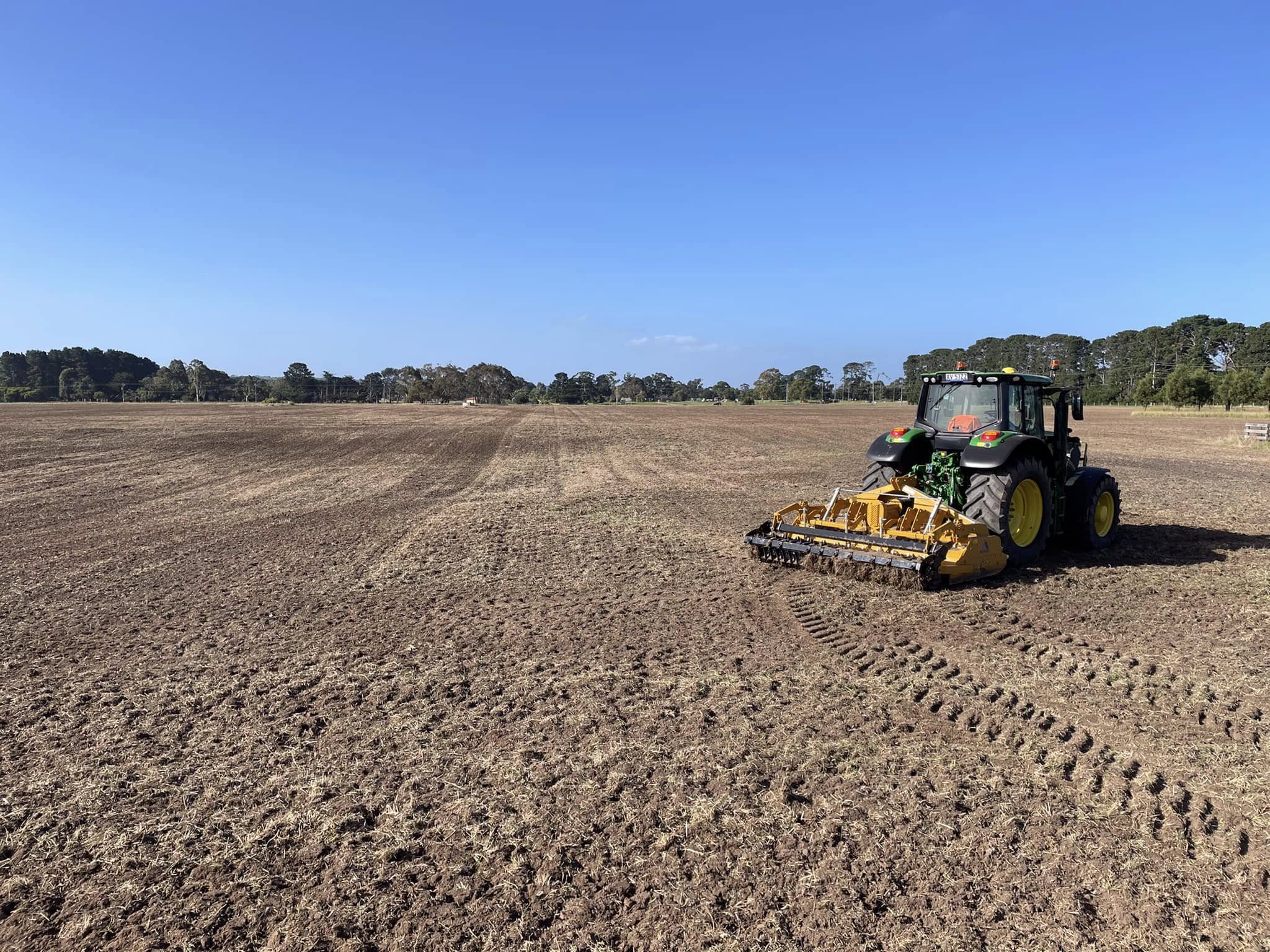
Book offset discing in Northern Victoria for residue-heavy paddocks before sowing—discuss field conditions and timing with Malkin Group.
Post-harvest residue and uneven ground can restrict the next cultivation pass, but offset discing is not a universal prescription. The right decision depends on soil moisture, residue load, paddock history and the intended seeding system.
What Is Offset Discing?
Offset discing is a cultivation method that uses angled gangs of concave discs to cut and mix soil and surface residue. Malkin Group lists offset discing within its agricultural contracting services, alongside speed discing, deep ripping, power harrowing, rotary hoeing, ploughing, seeding and other pasture services.
For growers, the commercial question is whether an offset disc is appropriate for the paddock—not whether discing is generally “good”. Soil structure, erosion exposure, compaction, weed strategy and follow-up operations must be considered before work is scheduled.
When Can Offset Discing Be Considered?
An offset disc may be discussed where the objective is to:
- Incorporate substantial surface residue
- Break down rough ground after previous operations
- Prepare a paddock for a planned cultivation sequence
- Improve machinery access through dense surface material
- Work within a limited pre-sowing programme
The required depth and number of passes should respond to actual conditions. Excessive or poorly timed cultivation can damage soil structure, lose moisture and leave soil vulnerable to erosion. Agriculture Victoria’s soil management guidance reinforces the need to manage soil condition rather than applying the same treatment everywhere.
Offset Discing or Speed Discing?
These services should not be treated as interchangeable keywords. Offset discs are generally associated with more aggressive soil and residue movement, while speed discs are commonly used for faster, shallower incorporation. The appropriate option depends on machinery configuration, soil type, moisture and the desired finish.
Ask the contractor to discuss:
- Current stubble type, volume and distribution
- Soil moisture and known compaction issues
- Paddock size, access and obstacles
- Target sowing date and next machinery pass
- Desired cultivation depth and surface finish
- Areas that should be avoided or managed separately
This creates a useful service enquiry and prevents the job from being quoted on acreage alone.
Plan Around the Sowing Window
Seasonal availability can tighten quickly across broadacre regions. Provide paddock locations, approximate hectares, access details and the required completion window early. If material or machinery also needs to be moved, Malkin Group provides agricultural machinery transport and cartage for grain, fertiliser and other bulk products.
Malkin Group services agricultural customers across the Mornington Peninsula, Northern Victoria and southern New South Wales. Its published cultivation range supports a coordinated programme, but the contractor should still inspect or discuss paddock conditions before recommending an operation.
Request a Paddock-Specific Quote
Generic promises about “perfect seedbeds” are unreliable because field outcomes depend on weather, soil and the complete cultivation plan. A stronger approach is to define the paddock problem, the next operation and the deadline.
Need residue-heavy paddocks assessed before the sowing window closes? Contact Malkin Group with the location, hectares, residue conditions and target timing to discuss offset discing in Northern Victoria.
Optimized by: Netwizard SEO